A problem from Litton Mathematical Recreations, which attributes it to Fermat circa 1635:


What is the remainder upon dividing 5999,999 by 7?

When successive powers of 5 are divided by 7, the remainders form a repeating series:
51 / 7 = 0 remainder 5
52 / 7 = 3 remainder 4
53 / 7 = 17 remainder 6
54 / 7 = 89 remainder 2
55 / 7 = 446 remainder 3
56 / 7 = 2232 remainder 1
57 / 7 = 11160 remainder 5
58 / 7 = 55803 remainder 4
59 / 7 = 279017 remainder 6
510 / 7 = 1395089 remainder 2

The 999,999th term of the series is 6.

1234567891, 12345678901234567891, and 1234567891234567891234567891 are prime.

So are

19
197
1979
19793
197933
1979339
19793393 and
197933933.

And so are

742950290870000078092059247
742950290871010178092059247
742950290872020278092059247
742950290873030378092059247
742950290874040478092059247
742950290875050578092059247
742950290876060678092059247
742950290877070778092059247
742950290878080878092059247 and
742950290879090978092059247.

If the nth term of the Fibonacci series is prime, then n also is prime (where n > 4). For example, the 17th term, 1597, is prime, and 17 is prime.

Endeavour for Endeavour

What would it be like to fly a space shuttle? Although the last of NASA's space shuttles has now been retired, it is still fun to contemplate sitting at the controls of one of the humanity's most sophisticated machines. Pictured above is the flight deck of Space Shuttle Endeavour, the youngest shuttle and the second to last ever launched. The numerous panels and displays allowed the computer-controlled orbiter to enter the top of Earth's atmosphere at greater than the speed of sound and -- just thirty minutes later -- land on a runway like an airplane. The retired space shuttles are now being sent to museums, with Endeavour being sent to California Space Center in Los Angeles, California, Atlantis to the Kennedy Space Center Visitor Complex on Merritt Island, Florida, and Discovery to the Udvar-Hazy Annex of the National Air and Space Museum in Chantilly, Virginia. Therefore sitting in a shuttle pilot's chair and personally contemplating the thrill of human space flight may actually be in your future.

The Brain is Full of Surprises

Maybe you heard about the study published last week that compared the brain’s wiring to the streets of Manhattan. It made me wonder if this had anything to do with how active my brain’s fear center gets when I’m in the back of a New York taxi, but apparently the scientists did not see the value of this line of research.

They did, however, find that the connections in our brains seem to follow a fairly basic design, that instead of resembling a bowl of tangled spaghetti, as once thought, they’re laid out like a grid. (Well, that’s reassuring.) And, says the study’s lead author, Van Wedeen, of Harvard Medical School, that helps clarify how a relatively small number of genes can produce a blueprint for something so complex. It also explains how the basic brain of a flatworm could evolve into a stunningly complicated human mind. To extend Wedeen’s Manhattan analogy, it’s a case of adding a lot more streets to the grid.

The value of the study, along with other major brain mapping undertakings, such as the Human Connectome Project, is that they’ll help scientists see what goes wrong to cause disorders such as autism and Alzheimer’s disease.

more at http://blogs.smithsonianmag.com/ideas/2012/04/the-brain-is-full-of-surprises/

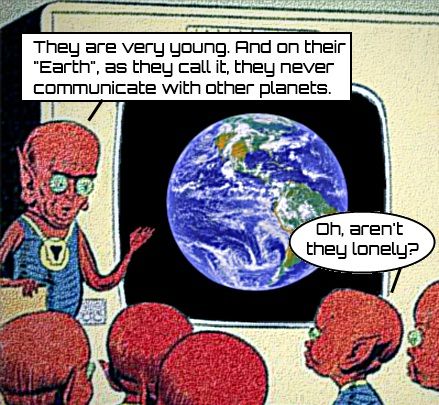
Are we alone?


It’s impossible to trisect an angle using a compass and a straightedge, but in 1947 Leo Moser showed how to do it with a pocketwatch. At noon align the watch’s hands with one side of the angle (above, XII), then wait until the minute hand has crossed to the other side (III). At that point the hour hand will have measured one-twelfth of the angle. Double that twice and you have your trisection.

“Now you can trisect an angle anytime, anyplace, for anyone who asks,” writes Underwood Dudley in A Budget of Trisections. “But no one ever will.”

WE'RE IN THE POSITION OF A VISITOR FROM ANOTHER DIMENSION WHO COMES TO EARTH AND SEES A CHESS MATCH.  ASSUMING HE KNOWS IT'S A GAME, HE'S GOT TWO PROBLEMS: FIRST, FIGURE OUT THE RULES, AND SECOND, FIGURE OUT HOW TO WIN.
 NINETY PERCENT OF SCIENCE (INCLUDING VIRTUALLY ALL OF CHEMISRY) IS IN THAT SECOND CATEGORY.  THEY'RE TRYING TO APPLY THE LAWS THAT ARE ALREADY KNOWN.

                     -- SHELDON GLASHOW, 1979
    Richard Feynman, the late Caltech physicist, is famous for working on the atomic bomb, winning a Nobel Prize in Physics, cracking safes, playing drums and driving a 1975 Dodge Maxivan adorned with squiggly lines on the side panels. Most people who saw it gazed in puzzlement, but once in a while someone would ask the driver why he had Feynman diagrams all over his van, only to be told, “Because I’m Richard Feynman!”

    Feynman diagrams are simplified visual representations of the very complex world of quantum electrodynamics (QED), in which particles of light called photons are depicted by wavy lines, negatively charged electrons are depicted by straight or curved nonwavy lines, and line junctions show electrons emitting or absorbing a photon. In the diagram on the back door of the van, seen in the photograph above with Tufte, time flows from bottom to top. The pair of electrons (the straight lines) are moving toward each other. When the left-hand electron emits a photon (wavy-line junction), that negatively charged particle is deflected outward left; the right-hand electron reabsorbs the photon, causing it to deflect outward right.

Is Carbon di oxide Poisonous?

Carbon dioxide is a gas that is present in the air you breathe. Plants "breathe" it in order to make glucose. You exhale carbon dioxide gas as a by-product of respiration. Carbon dioxide in the atmosphere is one of the greenhouse gases. You find it added to soda, naturally occurring in beer, and in its solid form as dry ice. Based on what you know, do you think carbon dioxide is poisonous or is it non-toxic or somewhere in between?

Ordinarily, carbon dioxide is not poisonous. It diffuses from your cells into your bloodstream and from there out via your lungs, yet it is always present throughout your body.

However, if you breathe high concentrations of carbon dioxide or re-breathe air (such as from a plastic bag or tent), you may be at risk for carbon dioxide intoxication or even carbon dioxide poisoning. Carbon dioxide intoxication and carbon dioxide poisoning are independent of oxygen concentration, so you may have enough oxygen present to support life, yet still suffer from the effects of rising carbon dioxide concentration in your blood and tissues. Symptoms of carbon dioxide toxicity include high blood pressure, flushed skin, headache and twitching muscles. At higher levels, you could experience panic, irregular heartbeat, hallucinations, vomited and potentially unconsciousness or even death.

Beauty: M=O/C

In 1933, Harvard mathematician George Birkhoff quantified beauty. The basic idea, he said, is that M = O/C, where M is the “aesthetic measure,” O is order, and C is complexity. By elaborating this principle into specific formulas, he decided that the square is the most pleasing polygon and the major triad the most pleasing diatonic chord. Of eight vases he considered, a Ming jar ranked highest, with M = 0.80, and in poetry the opening of Colerige’s “Kubla Khan” received an M rating of 0.83. The same principles can be applied to painting, sculpture, and architecture.

This kind of use of the formula leads at once to certain well known aesthetic maxims:

Unify as far as possible without loss of variety (that is, diminish the complexity C without decrease of the order O).
Achieve variety in so far as possible without loss of unity (that is, increase O without increase of C).
This ‘unity in variety’ must be found in the several parts as well as in the whole (that is, the order and complexity of the parts enter into the order and complexity of the whole).

“Now it seems to me that the postulation of genius in any mystical sense is unnecessary,” he concluded. “The analytic phase appears as an inevitable part of aesthetic experience. The more extensive this experience is, the more definite becomes the analysis.”

#The_Singularity_is_Nearer: When we merge with AI - Ray_Kurzweil - #Review

    The book starts with “where we stand” in terms of epochs with the present one being a merger of bio-science with technology. The idea th...