Dirac's Poser

While a student at Cambridge, Paul Dirac attended a mathematical congress that posed the following problem:

After a big day’s catch, three fisherman go to sleep next to their pile of fish. During the night, one fisherman decides to go home. He divides the fish in three and finds that this leaves one extra fish. He throws this into the water, takes one third of the remaining fish, and departs.

The second fisherman awakes. Not knowing that the first has left, he too divides the fish into three piles, finds one fish left over, discards it, and takes a third of the remainder. The third fisherman does the same. What is the least number of fish that the fishermen could have started with?

Dirac proposed that they had begun with -2 fish. The first fisherman threw one into the water, leaving -3, and took a third of this, leaving -2. The second and third fisherman followed suit.

This story was recalled by “a well-meaning experimenter” in the Russian miscellany Physicists Continue to Laugh (1968). “I could tell many other stories about theoreticians and their work,” he wrote, “but they have told me that one theoretician is writing a story under the title ‘How Experimental Physicists Work.’ That, of course, will be presented upside down.”

Of the integers from 1 to 1,000,000, which are more numerous: the numbers that contain a 1 or those that don’t?

To list the numbers that don’t contain a 1, imagine six spaces and fill each with the digits 0, 2, 3, 4, 5, 6, 7, 8, or 9. The number of ways of doing this is 96. There’s one exception: 000000 doesn’t fall between 1 and 1,000,000. So the number of integers without 1 is 96 – 1 = 531,440, and the number with 1 is 468,560.

Transversal of primes


Choose a prime number p, draw a p×p array, and fill it with integers like so:

Now: Can we always find p cells that contain prime numbers such that no two occupy the same row or column? (This is somewhat like arranging rooks on a chessboard so that every rank and file is occupied but no rook attacks another.)

The example below shows one solution for p=11. Does a solution exist for every prime number? No one knows.

A problem from Litton Mathematical Recreations, which attributes it to Fermat circa 1635:


What is the remainder upon dividing 5999,999 by 7?

When successive powers of 5 are divided by 7, the remainders form a repeating series:
51 / 7 = 0 remainder 5
52 / 7 = 3 remainder 4
53 / 7 = 17 remainder 6
54 / 7 = 89 remainder 2
55 / 7 = 446 remainder 3
56 / 7 = 2232 remainder 1
57 / 7 = 11160 remainder 5
58 / 7 = 55803 remainder 4
59 / 7 = 279017 remainder 6
510 / 7 = 1395089 remainder 2

The 999,999th term of the series is 6.

1234567891, 12345678901234567891, and 1234567891234567891234567891 are prime.

So are

19
197
1979
19793
197933
1979339
19793393 and
197933933.

And so are

742950290870000078092059247
742950290871010178092059247
742950290872020278092059247
742950290873030378092059247
742950290874040478092059247
742950290875050578092059247
742950290876060678092059247
742950290877070778092059247
742950290878080878092059247 and
742950290879090978092059247.

If the nth term of the Fibonacci series is prime, then n also is prime (where n > 4). For example, the 17th term, 1597, is prime, and 17 is prime.

Endeavour for Endeavour

What would it be like to fly a space shuttle? Although the last of NASA's space shuttles has now been retired, it is still fun to contemplate sitting at the controls of one of the humanity's most sophisticated machines. Pictured above is the flight deck of Space Shuttle Endeavour, the youngest shuttle and the second to last ever launched. The numerous panels and displays allowed the computer-controlled orbiter to enter the top of Earth's atmosphere at greater than the speed of sound and -- just thirty minutes later -- land on a runway like an airplane. The retired space shuttles are now being sent to museums, with Endeavour being sent to California Space Center in Los Angeles, California, Atlantis to the Kennedy Space Center Visitor Complex on Merritt Island, Florida, and Discovery to the Udvar-Hazy Annex of the National Air and Space Museum in Chantilly, Virginia. Therefore sitting in a shuttle pilot's chair and personally contemplating the thrill of human space flight may actually be in your future.

The Brain is Full of Surprises

Maybe you heard about the study published last week that compared the brain’s wiring to the streets of Manhattan. It made me wonder if this had anything to do with how active my brain’s fear center gets when I’m in the back of a New York taxi, but apparently the scientists did not see the value of this line of research.
They did, however, find that the connections in our brains seem to follow a fairly basic design, that instead of resembling a bowl of tangled spaghetti, as once thought, they’re laid out like a grid. (Well, that’s reassuring.) And, says the study’s lead author, Van Wedeen, of Harvard Medical School, that helps clarify how a relatively small number of genes can produce a blueprint for something so complex. It also explains how the basic brain of a flatworm could evolve into a stunningly complicated human mind. To extend Wedeen’s Manhattan analogy, it’s a case of adding a lot more streets to the grid.

The value of the study, along with other major brain mapping undertakings, such as the Human Connectome Project, is that they’ll help scientists see what goes wrong to cause disorders such as autism and Alzheimer’s disease.

more at http://blogs.smithsonianmag.com/ideas/2012/04/the-brain-is-full-of-surprises/

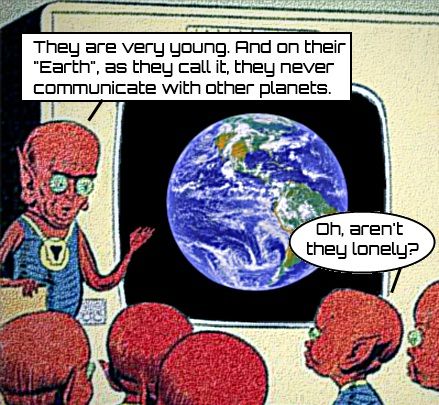
Are we alone?


It’s impossible to trisect an angle using a compass and a straightedge, but in 1947 Leo Moser showed how to do it with a pocketwatch. At noon align the watch’s hands with one side of the angle (above, XII), then wait until the minute hand has crossed to the other side (III). At that point the hour hand will have measured one-twelfth of the angle. Double that twice and you have your trisection.

“Now you can trisect an angle anytime, anyplace, for anyone who asks,” writes Underwood Dudley in A Budget of Trisections. “But no one ever will.”

WE'RE IN THE POSITION OF A VISITOR FROM ANOTHER DIMENSION WHO COMES TO EARTH AND SEES A CHESS MATCH.  ASSUMING HE KNOWS IT'S A GAME, HE'S GOT TWO PROBLEMS: FIRST, FIGURE OUT THE RULES, AND SECOND, FIGURE OUT HOW TO WIN.
 NINETY PERCENT OF SCIENCE (INCLUDING VIRTUALLY ALL OF CHEMISRY) IS IN THAT SECOND CATEGORY.  THEY'RE TRYING TO APPLY THE LAWS THAT ARE ALREADY KNOWN.

                     -- SHELDON GLASHOW, 1979

#The_Singularity_is_Nearer: When we merge with AI - Ray_Kurzweil - #Review

    The book starts with “where we stand” in terms of epochs with the present one being a merger of bio-science with technology. The idea th...