Why Does the World Exist : Jim Holt - Review


The central theme of the book being "Why is there something rather than nothing", made an attractive start up. The author has interviewed about 50-60 illustrious personalities like John Updike, David Deutsch, Adolf Grünbaum, John Leslie, Derek Parfit, Roger Penrose, Richard Swinburne and Steven Weinberg (has missed mentioning Abuds Salam for the theory both were credited). A few have taken the question seriously and a few sarcastically. The answers are not objective and have run into descriptive pages which are interesting. After a few chapters (like 5 or 6 out of 25), the interest wanes as some philosophical points diffuses into unnecessarily drifted topics (away from the central theme). There is mention about Buddha, Imam Ghazali and the 'invention of zero' by 'Hindu' as Shunya.  Platonic World and Multiverse are a few new things I learnt here. 

A few 'questions' have been the answer for his questions; for the Big Bang : What banged? and Why did it Bang? What is Life without numbers? Where do all roads lead to? "What is it that breathes fire into equations and makes a universe for them to describe?  Why does the universe go through all the bother of existing?" etc.

For those who would like to go in search of understanding Universe (and no one has so far understood), this book may prove to be an ontological sojourn of refreshment for brain. Quite a few books have come out good on theory of Universal existence, but no one has ever touched on the topic "mother". His narration of how he sees his mother facing cancer and later death makes an interesting reading. Her mother had even won a local Tennis tournament a few years before her death and his love for the mother is reflective in his last part of the book where he does not say she died, but was transferred!

The Elegant Universe Superstrings, Hidden Dimensions, and the Quest for the Ultimate Theory - Brian Greene - Review

What is there in Strings Theory? What are hyper-dimensions? How does the area of a given geometry change when the shapes change? I have always wanted to know these. Though we have several books on relativity and quantum mechanics no book covers the hot-topic as this book has covered. For the first time I got to know calabi Yau.

Greene touches topics on his own contributions to super-string theory, as he is well-qualified to cover this aspect. Thankfully, he is also a clear and engaging writer, and this is one of the most readable science books I've read while still being assured that it would be accurate.

He presents conclusion and then the proof!, which may take out interest at times but towards the end of the book I think the difficulty of the material begins to overwhelm his ability to explain it clearly to the layman without mathematics. Each chapter, I felt, would not be complete until the next one was touched. The continuity is felt throughout, but at times you would need a break either to digest what he has said or to bring back concentration, particularly on string theory.

The first few chapters are a brief but comprehensive introduction to the basics of special relativity, general relativity, quantum mechanics, and their conflict, and are worth the price of the book by themselves. I've read innumerable explanations of relativity before, from physics textbooks to posts on the net, and this book's introduction still clarified for me things that I'd not really understood.

It may even help with the details of what goes with general relativity and what goes with special relativity. The quantum mechanics is not quite as good, but then quantum mechanics is harder to explain, and Greene does a competent job at introducing the important bits that will matter for the story of super-string theory (Like Perturbation Theory and Approximation methods).


The heart of this book, of course, is the explanation of just what superstring theory is, why people care about it, and what it's status is at the time of the writing of the book. With this, I was quite satisfied. Superstring theory is a hard topic to explain, given the esoteric circumstances under which it diverges from established theories, its use of ten- and eleven-dimensional space with folded dimensions, and its close association with topology theory .

The importance of unification of quantum mechanics with general relativity makes sense, but I didn't understand how he could express dissatisfaction with quantum mechanics for requiring that the weights of fundamental particles be experimentally determined rather than predicted.

But the most significant thing I found in this book was how multi-dimensions can be unfolded and how large distances can be traveled without travelling at the speed of light using Worm-holes. Quite good reasons he has to show this is possible. The text is quite readable without the end notes, and a non-scientific reader likely is better off skipping them.

The end of the book has a very interesting summary of each chapter. A must read for every 'reader'.

Reviewed most


A Portrait of Global Winds

High-resolution global atmospheric modeling provides a unique tool to study the role of weather within Earth’s climate system. NASA’s Goddard Earth Observing System Model (GEOS-5) is capable of simulating worldwide weather at resolutions as fine as 3.5 kilometers.
This visualization shows global winds from a GEOS-5 simulation using 10-kilometer resolution. Surface winds (0 to 40 meters/second) are shown in white and trace features including Atlantic and Pacific cyclones. Upper-level winds (250 hectopascals) are colored by speed (0 to 175 meters/second), with red indicating faster.
This simulation ran on the Discover supercomputer at the NASA Center for Climate Simulation. The complete 2-year “Nature Run” simulation— a computer model representation of Earth's atmosphere from basic inputs including observed sea-surface temperatures and surface emissions from biomass burning, volcanoes and anthropogenic sources—produces its own unique weather patterns including precipitation, aerosols and hurricanes. A follow-on Nature Run is simulating Earth’s atmosphere at 7 kilometers for 2 years and 3.5 kilometers for 3 months.
Image Credit: William Putman/NASA Goddard Space Flight Center

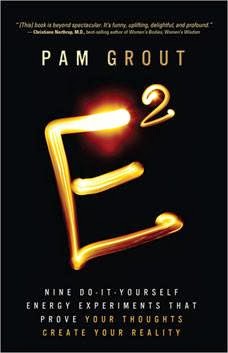
E-Squared: Nine Do-It-Yourself Energy Experiments That Prove Your Thoughts Create Your Reality - Pam Grout


The E-square actually deceived me into reading it as I thought it was a Science writing when a glance on it mentioned about 'experiments' along with this "E=MC^2" reference, and it turned out to be a book like 'How to win..., how to count chicks...The Secret..., The Winner within....'etc. 

But then there is a great difference for the good. The book is all about energy and how one can either squander it mindlessly or use it to his/her advantage. It has a good collection of significant quotes by eminent scientists and there are punch lines that would give one the reason to
cheer in life. The NINE 'thought experiments' are systematically and 'thermodynamically' listed out in the order they should give the reader the reason to smile and reflect upon.

It proves the following:
1. There is an invisible energy force or field of infinite possibilities.
2. You impact the field and draw from it according to your beliefs and
expectations.
3. You, too, are a field of energy.
4. Whatever you focus on expands.
5. Your connection to the field provides accurate and unlimited guidance.
6. Your thoughts and consciousness impact matter.
7. Your thoughts and consciousness provide the scaffolding for your physical body.
8. You are connected to everything and everyone else in the universe.
9. The universe is limitless, abundant, and strangely accommodating.

For the beginners, graduates and the alike, this book would be an excellent choice to read.

A lady author well performed!

Material Science to the fore - the Nano Satellites


Cubesats Released From Space Station
ISS038-E-003872 (19 Nov. 2013) --- Three nanosatellites, known as Cubesats, are deployed from a Small Satellite Orbital Deployer (SSOD) attached to the Kibo laboratory’s robotic arm at 7:10 a.m. (EST) on Nov. 19, 2013. Japan Aerospace Exploration Agency astronaut Koichi Wakata, Expedition 38 flight engineer, monitored the satellite deployment while operating the Japanese robotic arm from inside Kibo. The Cubesats were delivered to the International Space Station Aug. 9, aboard Japan’s fourth H-II Transfer Vehicle, Kounotori-4.
Image Credit: NASA

“Whether you can observe a thing or not depends on the theory which you use. It is the theory which decides what can be observed.” — Albert Einstein

“Man, surrounded by facts, permitting himself no surprise, no intuitive flash, no great hypothesis, no risk, is in a locked cell. Ignorance cannot seal the mind more securely.” —ALBERT EINSTEIN
“Everyone who is seriously involved in the pursuit of science becomes convinced that a spirit is manifest in the laws of the universe—a spirit vastly superior to that of man.” —ALBERT EINSTEIN

How to Teach Relativity to Your Dog! - Chad Orzel - Review


ARRIVING BEFORE YOU LEFT!

Great idea : "What we see in the Universe are all, in fact, disguised aspects of a single interaction."

Brilliant mistake: We often assume that the concept of relativity is beyond our understanding and is not vital for understanding. This book would really take you to the concept of understanding the 'limitations' with which we are living.

Know this: Complex Einsteinian ideas like the slowing of time for a moving observer, the shrinking of moving objects, the effects of gravity on light and time, black holes, the Big Bang, with simple examples would make even a lay man understand the concepts of 'LIFE' - may be that is why the author thought he would teach that to his dog!

Regret: There is a good analysis for Einstein's comment about "greatest blunder of his life". Unfortunately, he is not alive to see how his 'cosmological constant' is being used now a days by many Physicsts to describe the expanding Universe.

Humorous Aspect: The most important thing I liked in this book is when the authors' dog spills the coffee by mistake after which it starts roaming around the room, speeder and speeder, and when the author asked why it was doing so, it replied, "I want to move faster and faster so that I can slow the time and slowing this would at some stage stop the time or take me to the PAST. Once in the 'PAST', I would 'restore' the spilled coffee"! Humorous, but a true concept.

I would recommend this as 'must-read' for all - I mean all.

#The_Singularity_is_Near: When Humans Transcend Biology - Ray_Kurzweil - #Review

      I have read this book nearly 20 years after its publication and more after finishing a second volume to this sequel  (when we merge wi...