Brilliant Blunders - Mario Livio - Review

Mistakes are portals of Discovery! Review

Mario Livio explores some of the most brilliant blunders in the history of science, but with a pinch of excessive elaboration, at least for those who are already aware of Darwin's ignorance of Mendel and Einstein's utterance about cosmological Constant.

While there are no shortage of legitimate mistakes in science , Livio focuses instead on what a handful of high-order blunders. The following are the main blunders that form the crux of this book:

1. Charles Darwin's theory of evolution conflicted with the understanding of heredity in his day: In the mid-1800's, before Mendel's experiments showed how heredity worked, scientists (including Darwin himself) believed that heredity worked by combining traits. So, for example, if you had a white moth and a black moth, if they mated then this would result in a gray moth. Unfortunately, this sort of heredity doesn't actually provide an environment in which his theory of evolution can really work, because any benefits from natural selection would eventually fade away in the background of the population.

2. Lord Kelvin's estimate of the age of the Earth: Using basic principles from physics and thermodynamics, Lord Kelvin estimated the length of time it would take for the newly-formed hot Earth to cool down into the temperature it is today. This theory assumed that there was no convection beneath the Earth's crust. His blunder is that when this was pointed out, he refused to even realistically consider that a fluid, melted core was a possibility! His prediction was drastic.

3. Linus Pauling almost discovered the double helix structure of DNA, but made a basic chemistry mistake in the model: The resulting model - created in haste in an effort to pre-empt publication by others. When Watson & Crick saw the flawed model, they rushed to get their model completed in time to beat Pauling to publication!

4. Fred Hoyle refused to abandon his steady state theory well after there was sufficient evidence to refute it: In an effort to avoid an origin predicted by the big bang theory, Fred Hoyle suggested a process of continual matter creation throughout the universe, called the steady state theory. The theory itself was perfectly reasonable when proposed, but as evidence mounted against it (such as the discovery of the cosmic microwave background radiation), Hoyle refused to acknowledge that his theory might be wrong and kept adjusting the theory in attempts to keep it viable.

5. Albert Einstein's introduction of the cosmological constant into general relativity: One of the first solutions to Einstein's equations of general relativity showed that it allowed for a universe that was expanding or contracting. To fit with his ideal of a static universe, Einstein introduced a term into the equation (allowed but not required by theoretical considerations) which kept the universe constant, neither expanding nor contracting. However, when Edwin Hubble discovered evidence that the universe was expanding, Einstein no longer saw it as necessary, so set the cosmological constant to 0. In 1998, evidence arose which suggested that some mysterious dark energy is causing the universe to expand, meaning that Einstein's cosmological constant may actually have a non-zero value anyway ... something that several of Einstein's peers suggested at the time. Livio also spends considerable time describing his investigation into the claim that Einstein called the introduction of the cosmological constant his "biggest blunder" ... and finds it wanting.

The book is a good narrative of these key moments in the development of science. The different blunders reveal the way science progressed and evolved.

The first part of the book, on Darwin's blunder is a bit too involved with genetics and forces a dry discussion. You must keep interest in the 'blunders' so that you pass through Kelvin's and finally reach Einstein. The later part of the book is interesting relatively and the best thing I found in this book is the 'Reference' the author has covered - a whopping >20% of the book itself!!

Hyperspace: A Scientific Odyssey Through Parallel Universes, Time Warps, and the 10th Dimension - Michiu Kaku - Review


Written in a simple manner Kaku takes us on a journey from finite to infinite with reasons. The entry into dimensions 1,2,3,4....10 is very lucid and with several proofs he makes us believe that there may be more dimensions we might 'think', particularly about light which has many peculiar properties (including the fastest wave) as a fall out of interacting dimensions. He reasons it with a fact that the electromagnetic radiations are every where and such a huge amount of radiation cannot exist without its own 'space'. We just do not have the 'equipment' to see these dimensions.

The talk of Mobius strip and Flatland (a book by Abbott E Abbott is referred) caught my attention. If we were in 2D only we would see only shadows.Nice. If you lived in a flatland and were folded into a Mobius strip and made to traverse you would probably see your heart moved from left side of the chest to right!

The matrix to describe super symmetry using Einstein, Maxwell and Yang-Mill is excellent (Gravity and light, Nuclear Force and Matter), the result of which could be leptons and muons. (just like bosons and fermions)

The importance of geometry is laid like this
Geometry —> field theory —> classical theory —> quantum theory
So, he seems to suggest we 'cook' up all the geometries of the molecules and materials and have enough evidence for such support using quantum theory, the development of which alone is the basis of all advanced materials science.

He pays rich tribute to many forgotten scientists and also mentions Srinvasan Ramanujan as to have come across some strange parameters amounting to 10 numbers which if assigned 10 dimensions could well solve the problem he proposed (Number Theory), using present day super computers.

The book can be sensed in two parts
First half of the book is the history of hyperspace, second half is what can come out of the theory and is a little bit uninteresting wherein Kaku expresses Sociology and Civilization along with COBE, Wormholes, Dimensions and Mathematics Time machine and blue print for it. A few good anecdotes like this one from Aquinas about Creator is catching:

Things are in motion, hence there is a first mover
Things are caused, hence there is a first cause
Things exist, hence there is a creator
Perfect goodness exists, hence it has a source
Things are designed, hence they serve a purpose

A good book for science lovers and even those who think they have no good science background can find this book interesting.

Kepler’s second law holds that a line segment connecting an orbiting planet to its sun sweeps out equal areas in equal periods of time: In the diagram above, if the time intervals t are equal, then so are the areas A.

If gravity were turned off, would this still be true?


(Below Picture) Yes. The planet would pass into space in a straight line, and each time interval would define a triangle with height h and base t. Since a triangle’s area is half the product of its height and base, they’re all equal.

Why Does the World Exist : Jim Holt - Review


The central theme of the book being "Why is there something rather than nothing", made an attractive start up. The author has interviewed about 50-60 illustrious personalities like John Updike, David Deutsch, Adolf Grünbaum, John Leslie, Derek Parfit, Roger Penrose, Richard Swinburne and Steven Weinberg (has missed mentioning Abuds Salam for the theory both were credited). A few have taken the question seriously and a few sarcastically. The answers are not objective and have run into descriptive pages which are interesting. After a few chapters (like 5 or 6 out of 25), the interest wanes as some philosophical points diffuses into unnecessarily drifted topics (away from the central theme). There is mention about Buddha, Imam Ghazali and the 'invention of zero' by 'Hindu' as Shunya.  Platonic World and Multiverse are a few new things I learnt here. 

A few 'questions' have been the answer for his questions; for the Big Bang : What banged? and Why did it Bang? What is Life without numbers? Where do all roads lead to? "What is it that breathes fire into equations and makes a universe for them to describe?  Why does the universe go through all the bother of existing?" etc.

For those who would like to go in search of understanding Universe (and no one has so far understood), this book may prove to be an ontological sojourn of refreshment for brain. Quite a few books have come out good on theory of Universal existence, but no one has ever touched on the topic "mother". His narration of how he sees his mother facing cancer and later death makes an interesting reading. Her mother had even won a local Tennis tournament a few years before her death and his love for the mother is reflective in his last part of the book where he does not say she died, but was transferred!

The Elegant Universe Superstrings, Hidden Dimensions, and the Quest for the Ultimate Theory - Brian Greene - Review

What is there in Strings Theory? What are hyper-dimensions? How does the area of a given geometry change when the shapes change? I have always wanted to know these. Though we have several books on relativity and quantum mechanics no book covers the hot-topic as this book has covered. For the first time I got to know calabi Yau.

Greene touches topics on his own contributions to super-string theory, as he is well-qualified to cover this aspect. Thankfully, he is also a clear and engaging writer, and this is one of the most readable science books I've read while still being assured that it would be accurate.

He presents conclusion and then the proof!, which may take out interest at times but towards the end of the book I think the difficulty of the material begins to overwhelm his ability to explain it clearly to the layman without mathematics. Each chapter, I felt, would not be complete until the next one was touched. The continuity is felt throughout, but at times you would need a break either to digest what he has said or to bring back concentration, particularly on string theory.

The first few chapters are a brief but comprehensive introduction to the basics of special relativity, general relativity, quantum mechanics, and their conflict, and are worth the price of the book by themselves. I've read innumerable explanations of relativity before, from physics textbooks to posts on the net, and this book's introduction still clarified for me things that I'd not really understood.

It may even help with the details of what goes with general relativity and what goes with special relativity. The quantum mechanics is not quite as good, but then quantum mechanics is harder to explain, and Greene does a competent job at introducing the important bits that will matter for the story of super-string theory (Like Perturbation Theory and Approximation methods).


The heart of this book, of course, is the explanation of just what superstring theory is, why people care about it, and what it's status is at the time of the writing of the book. With this, I was quite satisfied. Superstring theory is a hard topic to explain, given the esoteric circumstances under which it diverges from established theories, its use of ten- and eleven-dimensional space with folded dimensions, and its close association with topology theory .

The importance of unification of quantum mechanics with general relativity makes sense, but I didn't understand how he could express dissatisfaction with quantum mechanics for requiring that the weights of fundamental particles be experimentally determined rather than predicted.

But the most significant thing I found in this book was how multi-dimensions can be unfolded and how large distances can be traveled without travelling at the speed of light using Worm-holes. Quite good reasons he has to show this is possible. The text is quite readable without the end notes, and a non-scientific reader likely is better off skipping them.

The end of the book has a very interesting summary of each chapter. A must read for every 'reader'.

Reviewed most


A Portrait of Global Winds

High-resolution global atmospheric modeling provides a unique tool to study the role of weather within Earth’s climate system. NASA’s Goddard Earth Observing System Model (GEOS-5) is capable of simulating worldwide weather at resolutions as fine as 3.5 kilometers.
This visualization shows global winds from a GEOS-5 simulation using 10-kilometer resolution. Surface winds (0 to 40 meters/second) are shown in white and trace features including Atlantic and Pacific cyclones. Upper-level winds (250 hectopascals) are colored by speed (0 to 175 meters/second), with red indicating faster.
This simulation ran on the Discover supercomputer at the NASA Center for Climate Simulation. The complete 2-year “Nature Run” simulation— a computer model representation of Earth's atmosphere from basic inputs including observed sea-surface temperatures and surface emissions from biomass burning, volcanoes and anthropogenic sources—produces its own unique weather patterns including precipitation, aerosols and hurricanes. A follow-on Nature Run is simulating Earth’s atmosphere at 7 kilometers for 2 years and 3.5 kilometers for 3 months.
Image Credit: William Putman/NASA Goddard Space Flight Center

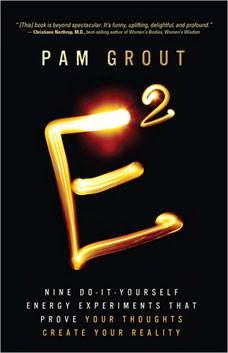
E-Squared: Nine Do-It-Yourself Energy Experiments That Prove Your Thoughts Create Your Reality - Pam Grout


The E-square actually deceived me into reading it as I thought it was a Science writing when a glance on it mentioned about 'experiments' along with this "E=MC^2" reference, and it turned out to be a book like 'How to win..., how to count chicks...The Secret..., The Winner within....'etc. 

But then there is a great difference for the good. The book is all about energy and how one can either squander it mindlessly or use it to his/her advantage. It has a good collection of significant quotes by eminent scientists and there are punch lines that would give one the reason to
cheer in life. The NINE 'thought experiments' are systematically and 'thermodynamically' listed out in the order they should give the reader the reason to smile and reflect upon.

It proves the following:
1. There is an invisible energy force or field of infinite possibilities.
2. You impact the field and draw from it according to your beliefs and
expectations.
3. You, too, are a field of energy.
4. Whatever you focus on expands.
5. Your connection to the field provides accurate and unlimited guidance.
6. Your thoughts and consciousness impact matter.
7. Your thoughts and consciousness provide the scaffolding for your physical body.
8. You are connected to everything and everyone else in the universe.
9. The universe is limitless, abundant, and strangely accommodating.

For the beginners, graduates and the alike, this book would be an excellent choice to read.

A lady author well performed!

Material Science to the fore - the Nano Satellites


Cubesats Released From Space Station
ISS038-E-003872 (19 Nov. 2013) --- Three nanosatellites, known as Cubesats, are deployed from a Small Satellite Orbital Deployer (SSOD) attached to the Kibo laboratory’s robotic arm at 7:10 a.m. (EST) on Nov. 19, 2013. Japan Aerospace Exploration Agency astronaut Koichi Wakata, Expedition 38 flight engineer, monitored the satellite deployment while operating the Japanese robotic arm from inside Kibo. The Cubesats were delivered to the International Space Station Aug. 9, aboard Japan’s fourth H-II Transfer Vehicle, Kounotori-4.
Image Credit: NASA

“Whether you can observe a thing or not depends on the theory which you use. It is the theory which decides what can be observed.” — Albert Einstein

#The_Singularity_is_Nearer: When we merge with AI - Ray_Kurzweil - #Review

    The book starts with “where we stand” in terms of epochs with the present one being a merger of bio-science with technology. The idea th...